 Germany
•
8 views
Germany
•
8 views
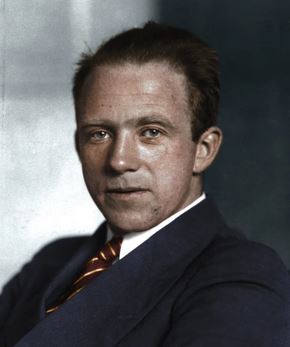
Werner Heisenberg

Würzburg (Bavaria), Germany
Archival Overview
German theoretical physicist and Nobel laureate who founded quantum matrix mechanics and discovered the Heisenberg Uncertainty Principle, establishing fundamental limits on physical measurement.
Biographical Record
Werner Karl Heisenberg (1901–1976) studied under Arnold Sommerfeld and Max Born, collaborating with Niels Bohr in Copenhagen. In 1925, during an allergy convalescence on Helgoland, Heisenberg made a breakthrough by constructing matrix mechanics—the first mathematically rigorous formulation of quantum theory.
In 1927, he formulated the famous Heisenberg Uncertainty Principle: Δx · Δp ≥ ℏ/2, proving that the more precisely a particle's position is determined, the less precisely its momentum can be known. This established that classical determinism does not govern atomic reality. Heisenberg was awarded the 1932 Nobel Prize in Physics for the creation of quantum mechanics.
Key Life Milestones
Creation of Quantum Matrix Mechanics
Published his seminal Helgoland paper replacing classical trajectories with observable transition matrices.
Formulation of the Uncertainty Principle
Published the Uncertainty Principle proving fundamental complementary measurement limits on position and momentum.
Memorial Guestbook & Tributes
0 messages recordedLeave a Respectful Tribute
Final Resting Place
Perpetual MemorialMunich, Germany