 British India (Pakistan)
•
3,464 views
British India (Pakistan)
•
3,464 views
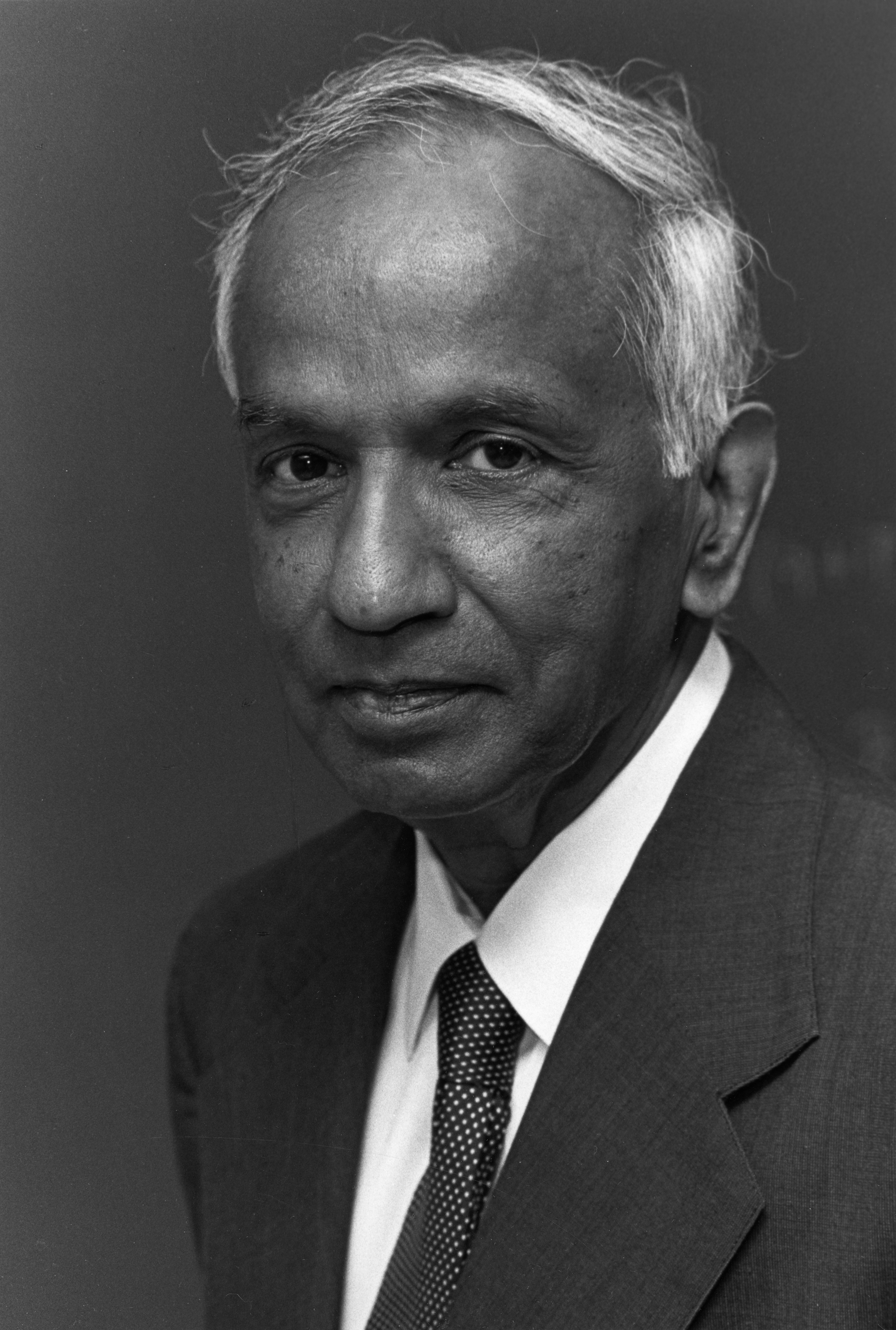
Subrahmanyan Chandrasekhar

Lahore, Punjab, British India (Pakistan)
Archival Overview
Indian-American astrophysicist who discovered the Chandrasekhar limit for white dwarf stars, earning the 1983 Nobel Prize.
Biographical Record
Subrahmanyan Chandrasekhar was an Indian-American theoretical astrophysicist whose mathematical formulations brought unparalleled precision to the understanding of stellar structure, radiative transfer, and black holes. The nephew of Nobel laureate C. V. Raman, 'Chandra' showed early mathematical genius at Presidency College, Madras, earning a scholarship to Cambridge University in 1930.
During his voyage aboard the ship to England at age nineteen, Chandra combined special relativity with quantum electron degeneracy pressure and calculated that a dying star exceeding 1.44 solar masses—now known as the Chandrasekhar limit—cannot support itself as a stable white dwarf and must inevitably collapse into a neutron star or black hole. Though initially publicly ridiculed by Arthur Eddington, his calculations were vindicated, earning him the 1983 Nobel Prize in Physics. Chandra spent nearly sixty years at the University of Chicago and served as managing editor of The Astrophysical Journal. NASA named the Chandra X-ray Observatory in his honor.
Key Life Milestones
The Chandrasekhar Limit
Calculated the maximum theoretical mass of a stable white dwarf star (1.44 solar masses) above which collapse is inevitable.
Nobel Prize in Physics
Awarded the Nobel Prize in Physics for his theoretical studies of the physical processes of importance to the structure and evolution of stars.
Memorial Guestbook & Tributes
0 messages recordedLeave a Respectful Tribute
Final Resting Place
Perpetual MemorialChicago, Illinois, United States