 British India (India)
•
2,920 views
British India (India)
•
2,920 views
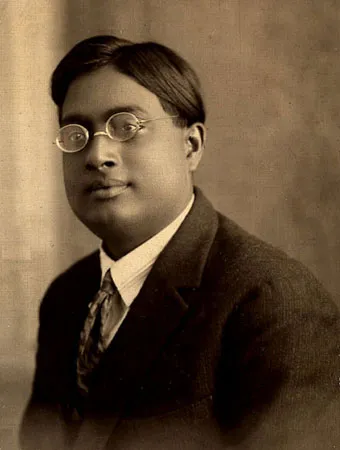
Satyendra Nath Bose

Calcutta, Bengal Presidency, British India (India)
Archival Overview
Eminent Indian polymath and theoretical physicist whose quantum statistics founded Bose-Einstein condensate theory and gave 'bosons' their name.
Biographical Record
Satyendra Nath Bose was an Indian theoretical physicist and polymath whose pioneering work on quantum statistics fundamentally altered modern physics. A brilliant mathematician educated at Presidency College in Calcutta, Bose was serving as reader in physics at the University of Dacca when he re-derived Planck's quantum radiation law in 1924 without referencing classical electrodynamics, treating photons as identical, indistinguishable particles obeying distinct statistical rules.
Unable to publish his paper in English journals, Bose mailed it directly to Albert Einstein with a handwritten note asking for translation. Einstein was astonished by its genius, translated it into German himself for the prestigious Zeitschrift für Physik, and extended Bose's concept to atoms, predicting the exotic fifth state of matter known as the Bose-Einstein Condensate (BEC). In Bose's honor, Paul Dirac coined the term bosons for all fundamental particles possessing integer spin—including photons, gluons, and the Higgs boson. Bose later served as vice-chancellor of Visva-Bharati University.
Key Life Milestones
Derivation of Bose Statistics
Authored the revolutionary paper deriving Planck's law using quantum statistics of indistinguishable photons, translated by Einstein.
Padma Vibhushan Award
Conferred the Padma Vibhushan, India's second-highest civilian honour, in recognition of his monumental contributions to science.
Memorial Guestbook & Tributes
0 messages recordedLeave a Respectful Tribute
Final Resting Place
Perpetual MemorialKolkata, West Bengal, India