 Great Britain
•
8 views
Great Britain
•
8 views
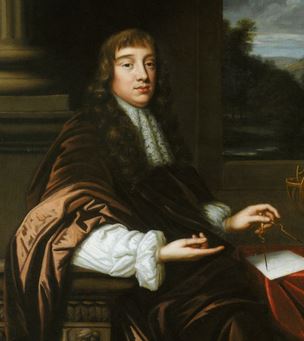
Robert Hooke

Freshwater (Isle of Wight), Great Britain
Archival Overview
Curator of Experiments to the Royal Society who coined the biological term 'cell' in Micrographia (1665), discovered Hooke's Law of elasticity, and rebuilt London after the Great Fire.
Biographical Record
Robert Hooke (1635–1703) was a mechanical genius of astonishing versatility. As Curator of Experiments to the Royal Society for over four decades, he was tasked with demonstrating multiple original scientific experiments at every weekly meeting.
In his 1665 bestseller Micrographia, featuring breathtaking fold-out copperplate engravings of fleas, eye structures, and plant tissue under compound microscopes, Hooke observed the honeycomb pore structure of cork bark, coining the word 'cell'. In physics, he formulated Hooke's Law of elasticity ($F = -kx$), invented the balance spring in pocket watches, the universal joint, and partnered with Christopher Wren to survey and rebuild London after the 1666 Great Fire.
Key Life Milestones
Publication of 'Micrographia' and Discovery of the Cell
Published his illustrated microscopic masterpiece, discovering and naming the biological 'cell' in cork bark.
Formulation of Hooke's Law of Elasticity
Published the law of spring tension: 'Ut tensio, sic vis' (as the extension, so the force).
Memorial Guestbook & Tributes
0 messages recordedLeave a Respectful Tribute
Final Resting Place
Perpetual MemorialLondon, United Kingdom