 United States
•
2 views
United States
•
2 views
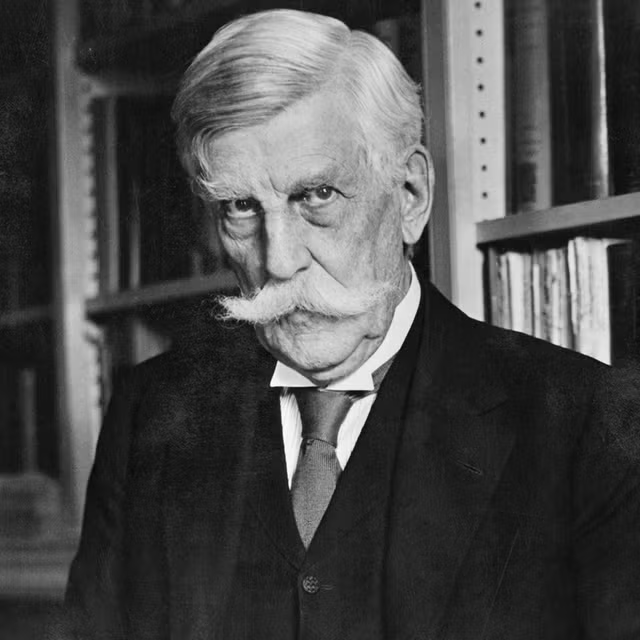
Oliver Wendell Holmes Jr.

Boston, Massachusetts, United States
Archival Overview
Supreme Court Justice known as 'The Great Dissenter' who formulated legal realism in The Common Law and defined the 'clear and present danger' test for free speech.
Biographical Record
Oliver Wendell Holmes Jr. (1841–1935) was an American jurist and legal scholar who served as an Associate Justice of the Supreme Court from 1902 to 1932. The son of the poet Oliver Wendell Holmes Sr., he fought with the 20th Massachusetts Volunteer Infantry in the Civil War, suffering three severe wounds at Ball's Bluff, Antietam, and Chancellorsville, which shaped his lifelong philosophical skepticism and tough-minded legal pragmatism.
In his 1881 masterpiece The Common Law, Holmes declared: 'The life of the law has not been logic: it has been experience'. Appointed to the Supreme Court by Theodore Roosevelt, Holmes became famous as 'The Great Dissenter', defending state economic regulations against substantive due process (Lochner v. New York). In Schenck v. United States (1919), he introduced the 'clear and present danger' doctrine and in Abrams v. United States formulated the iconic concept of the free 'marketplace of ideas'.
Key Life Milestones
The Common Law Published
Published The Common Law, transforming Anglo-American legal philosophy by demonstrating that law evolves with social history.
Free Speech Dissents (Abrams v. US)
Authored his historic dissent in Abrams v. US, establishing that truth is best reached through the free trade in ideas under the First Amendment.
Memorial Guestbook & Tributes
0 messages recordedLeave a Respectful Tribute
Final Resting Place
Perpetual MemorialArlington, Virginia, United States