 Netherlands
•
20 views
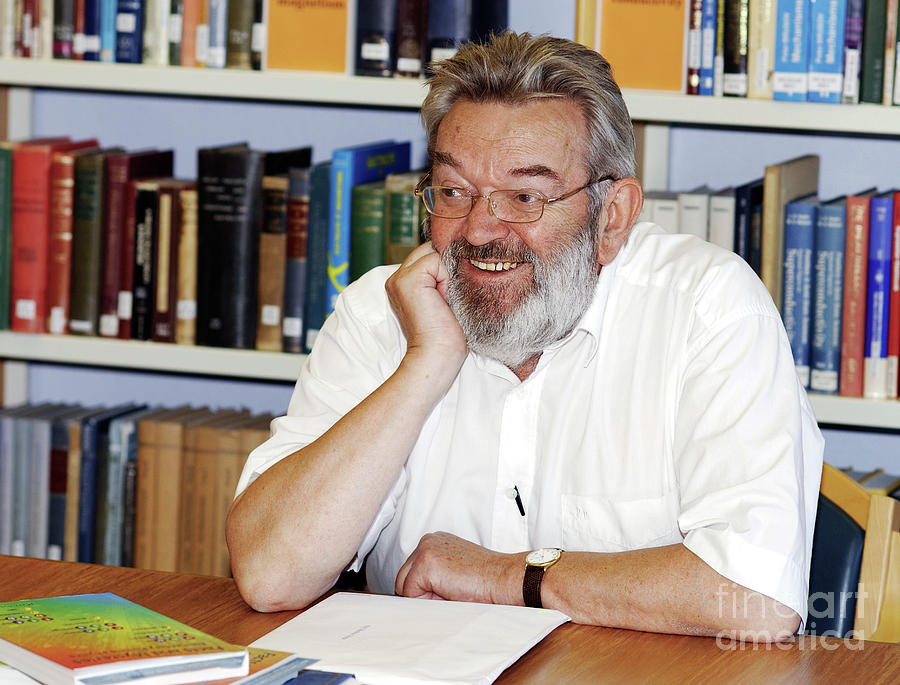
Martinus Justinus Godefridus Veltman

Waalwijk, Netherlands
Archival Overview
Dutch theoretical physicist awarded the 1999 Nobel Prize in Physics alongside his PhD student Gerard 't Hooft for mathematically proving the renormalizability of electroweak gauge theories, and creating the first computer algebra system, Schoonschip.
Biographical Record
Martinus Justinus Godefridus "Tini" Veltman was born in Waalwijk, Netherlands, and studied mathematics and physics at Utrecht University. Working at CERN in Geneva in the 1960s on neutrino experiments, he recognized that calculating high-order Feynman diagrams for gauge theories by hand was virtually impossible, prompting him to create Schoonschip (1963)—the pioneering computer algebra program that became the ancestor of systems like Mathematica and Maple.
Appointed professor at Utrecht, Veltman assigned the problem of non-Abelian gauge theories (Yang-Mills theories) to his brilliant doctoral student Gerard 't Hooft. In 1971, using Schoonschip, they proved that non-Abelian gauge theories with spontaneous symmetry breaking (the Higgs mechanism) are mathematically renormalizable, transforming the Standard Model of particle physics from speculative hypothesis into a predictive framework that anticipated the top quark and Higgs boson masses. They shared the 1999 Nobel Prize in Physics.
Key Life Milestones
Renormalization of Electroweak Theory
Published the breakthrough mathematical proof with Gerard 't Hooft showing electroweak Yang-Mills theories are renormalizable.
Nobel Prize in Physics
Awarded the Nobel Prize in Physics in Stockholm for elucidating the quantum structure of electroweak interactions.
Memorial Guestbook & Tributes
0 messages recordedLeave a Respectful Tribute
Final Resting Place
Perpetual MemorialBilthoven, Utrecht, Netherlands