 Czech Republic
•
4,199 views
Czech Republic
•
4,199 views
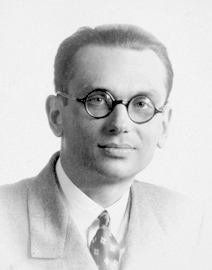
Kurt Gödel

Brünn, Moravia, Czech Republic
Archival Overview
Austrian-American logician who proved the Incompleteness Theorems, shattering mathematical formalist certainty.
Biographical Record
Kurt Friedrich Gödel was an Austrian-born American logician and mathematician whose breathtaking discoveries revolutionized mathematical logic, philosophy, and computer science. Educated at the University of Vienna where he attended meetings of the logical positivist Vienna Circle, Gödel completed his doctoral dissertation in 1929 by proving the completeness of first-order predicate logic.
In 1931, at age twenty-five, Gödel published his epochal paper containing the Incompleteness Theorems. He shattered David Hilbert's formalist dream of a complete and consistent mathematical system by proving that in any consistent axiomatic system capable of arithmetic, there are always true mathematical statements that can never be proven within the system itself; furthermore, such a system can never prove its own consistency. Fleeing Nazi-annexed Austria via the Trans-Siberian Railroad in 1940, Gödel joined the Institute for Advanced Study in Princeton, where he became Albert Einstein's closest daily walking companion. In 1949, Gödel discovered rotating cosmological solutions to Einstein's general relativity field equations (Gödel metric) that permit closed timelike curves (time travel).
Key Life Milestones
The Incompleteness Theorems
Published his two incompleteness theorems, proving that mathematical systems cannot be both fully complete and consistent.
Rotating Universes and Time Travel
Derived exact solutions to Einstein's general relativity equations permitting closed timelike curves, allowing theoretical time travel.
Memorial Guestbook & Tributes
0 messages recordedLeave a Respectful Tribute
Final Resting Place
Perpetual MemorialPrinceton, New Jersey, United States