 Kingdom of Great Britain
•
2,849 views
Kingdom of Great Britain
•
2,849 views
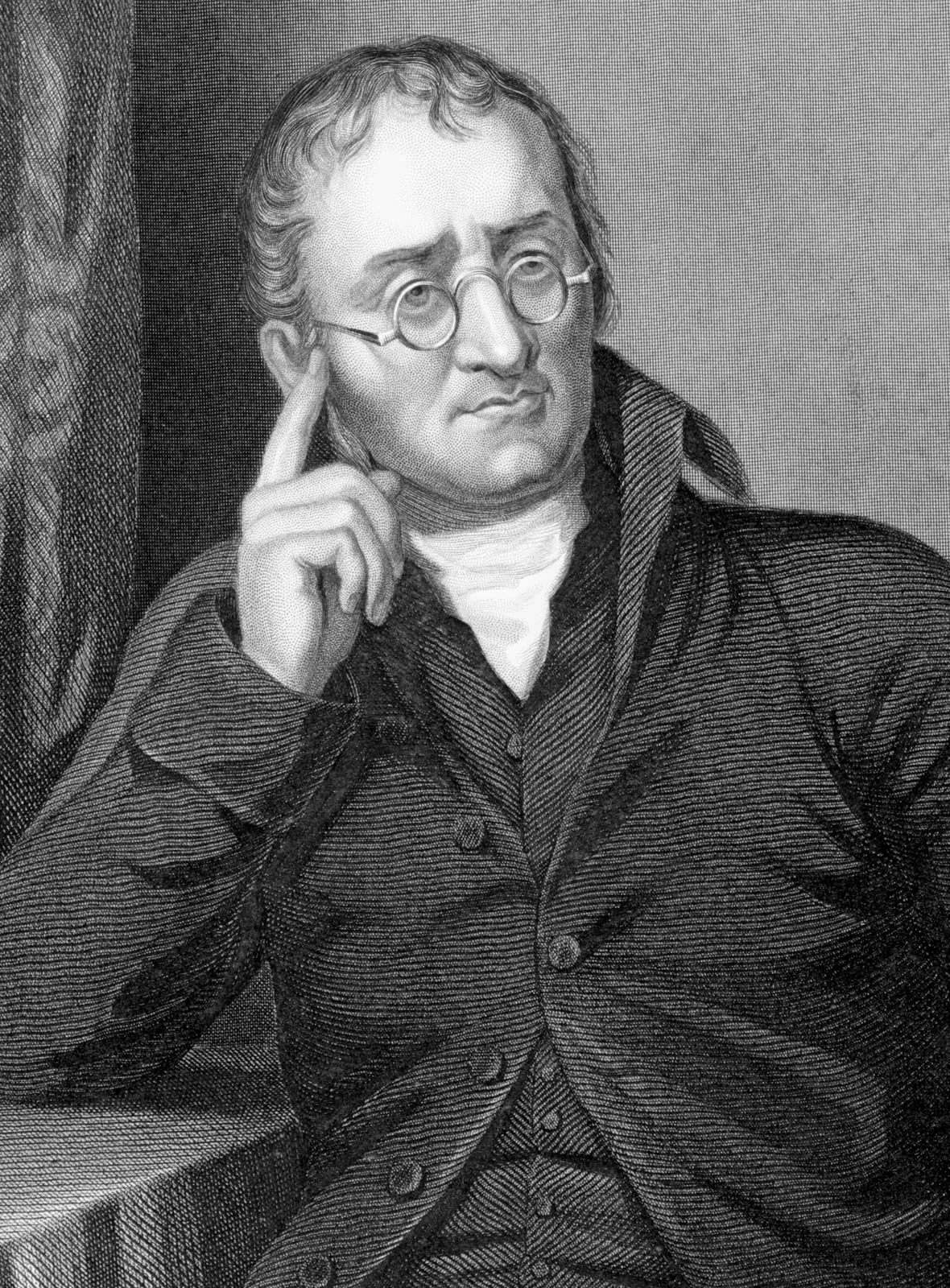
John Dalton

Eaglesfield, Cumberland, Kingdom of Great Britain
Archival Overview
English chemist and physicist who introduced the modern atomic theory into chemistry and pioneered research into color blindness.
Biographical Record
John Dalton was an English Quaker chemist, meteorologist, and natural philosopher whose humble lifestyle as a Manchester schoolteacher belied his revolutionary impact on physical science. Kept detailed daily meteorological logs for 57 years (recording over 200,000 observations), Dalton's interest in atmospheric gases led him to ponder their microscopic constitution.
In 1803, Dalton formulated the modern atomic theory: that all matter is composed of indivisible, indestructible particles called atoms; that atoms of a given element are identical in mass and properties; and that chemical compounds are formed when atoms combine in fixed, whole-number ratios (the Law of Multiple Proportions). He published the first table of relative atomic weights in his 1808 treatise A New System of Chemical Philosophy. Having recognized that both he and his brother could not distinguish red from green, Dalton also published the very first scientific paper on color blindness, which is still called Daltonism in many languages.
Key Life Milestones
Modern Atomic Theory
Proposed that chemical elements are composed of unique, indivisible atoms and formulated the Law of Multiple Proportions.
A New System of Chemical Philosophy
Published his masterpiece calculating the first table of atomic weights, founding modern quantitative chemistry.
Memorial Guestbook & Tributes
0 messages recordedLeave a Respectful Tribute
Final Resting Place
Perpetual MemorialManchester, United Kingdom