 United Kingdom
•
1,314 views
United Kingdom
•
1,314 views
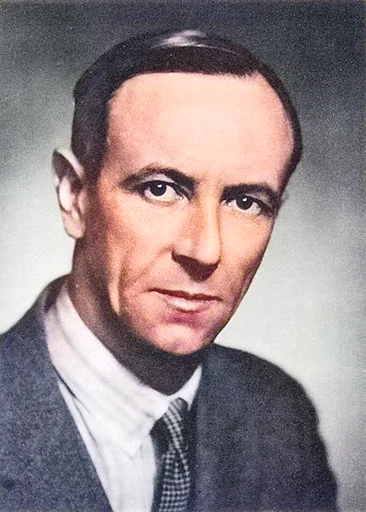
James Chadwick

Bollington, Cheshire, United Kingdom
Archival Overview
British physicist who discovered the neutron in 1932, paving the way for nuclear fission and atomic power.
Biographical Record
Sir James Chadwick was an English physicist whose discovery of the neutron transformed modern atomic theory and opened the gateway to nuclear physics. A dedicated student and protégé of Ernest Rutherford at Manchester and the Cavendish Laboratory in Cambridge, Chadwick had been interned in a German civilian detention camp during World War I, where he resourcefully improvised scientific apparatus from discarded toothbrushes and radioactive toothpaste.
In 1932, investigating puzzling experiments by Walther Bothe, Irène Joliot-Curie, and Frédéric Joliot, Chadwick bombarded beryllium atoms with alpha particles and proved that the resulting penetrating neutral radiation was not high-energy gamma rays, but a previously unobserved subatomic particle of mass similar to the proton: the neutron. For this discovery, he received the 1935 Nobel Prize in Physics. Because the uncharged neutron could penetrate heavy atomic nuclei without electrostatic repulsion, it became the ideal projectile for inducing nuclear fission. Chadwick later headed the British Mission to the Manhattan Project in the United States.
Key Life Milestones
Discovery of the Neutron
Proved the existence of the neutral subatomic particle through beryllium alpha-bombardment, completing the classic atomic nucleus model.
Nobel Prize in Physics
Awarded the Nobel Prize in Physics for the discovery of the neutron, which became the indispensable key to unlocking nuclear energy.
Memorial Guestbook & Tributes
0 messages recordedLeave a Respectful Tribute
Final Resting Place
Perpetual MemorialCambridge, United Kingdom