 Great Britain
•
9 views
Great Britain
•
9 views
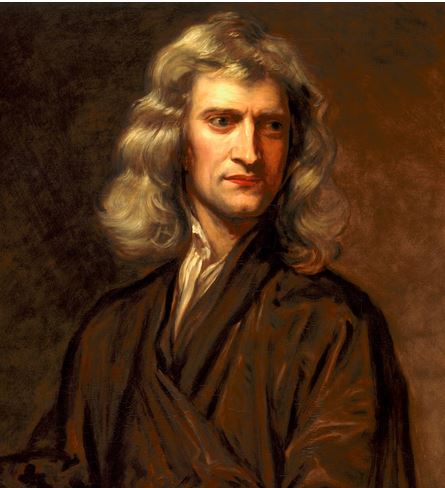
Sir Isaac Newton

Woolsthorpe Manor (Lincolnshire), Great Britain
Archival Overview
Supreme giant of science whose Philosophiæ Naturalis Principia Mathematica formulated the three laws of motion and universal gravitation, co-invented calculus, and discovered the color spectrum in light.
Biographical Record
Sir Isaac Newton (1643–1727) attended Trinity College, Cambridge, before returning to Woolsthorpe during the Great Plague of 1665–1666. In this legendary 'Annus Mirabilis', watching an apple fall in his mother's orchard, he conceived universal gravitation, differential calculus, and the spectral decomposition of white light through a glass prism.
Encouraged by Edmond Halley, Newton published his monumental Philosophiæ Naturalis Principia Mathematica in 1687, uniting heaven and earth under the three universal laws of motion and the inverse-square law of gravity ($F = G frac{m_1 m_2}{r^2}$). In his 1704 Opticks, he detailed his invention of the reflecting telescope. Knighted by Queen Anne in 1705, he presided over the Royal Society until his death.
Key Life Milestones
Publication of the 'Principia Mathematica'
Published the greatest work in scientific history, setting forth the three laws of motion and universal gravitation.
Publication of 'Opticks'
Demonstrated the chromatic spectrum of light, refraction, and the invention of the reflecting telescope.
Memorial Guestbook & Tributes
0 messages recordedLeave a Respectful Tribute
Final Resting Place
Perpetual MemorialLondon, United Kingdom