 Germany
•
7 views
Germany
•
7 views
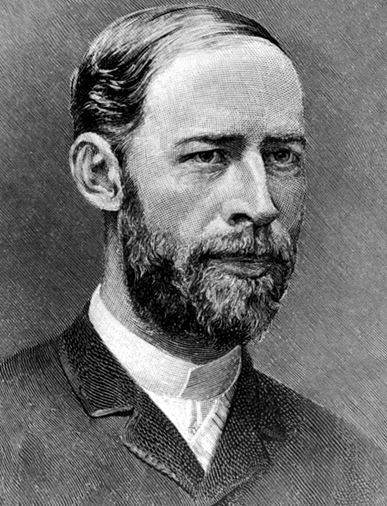
Heinrich Rudolf Hertz

Hamburg, Germany
Archival Overview
German experimental physicist who decisively proved the physical existence of electromagnetic waves, validating Maxwell's theory and laying the foundation for radio and wireless technology.
Biographical Record
Heinrich Rudolf Hertz (1857–1894) studied physics under Hermann von Helmholtz and Gustav Kirchhoff in Berlin. In 1885, as professor at the Karlsruhe Institute of Technology, Hertz designed an ingenious experimental apparatus using spark-gap transmitters and curved zinc parabolic reflectors.
Between 1886 and 1888, he successfully generated and detected radio waves (then termed Hertzian waves), demonstrating that they traveled at the speed of light and exhibited reflection, refraction, and polarization identical to light. Hertz also made the first observations of the photoelectric effect. In 1930, the SI unit of frequency (hertz, Hz) was named in his honor.
Key Life Milestones
Generation and Detection of Radio Waves
Built the first spark-gap oscillator and receiver, proving electromagnetic radiation propagates through free space.
Observation of the Photoelectric Effect
Discovered that ultraviolet illumination on spark electrodes facilitated electrical discharge, revealing the photoelectric effect.
Memorial Guestbook & Tributes
0 messages recordedLeave a Respectful Tribute
Final Resting Place
Perpetual MemorialBonn, Germany