 United States
•
23 views
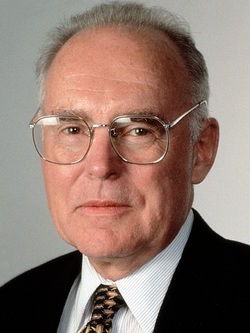
Gordon Earle Moore

San Francisco, United States
Archival Overview
American engineer, entrepreneur, and Intel co-founder who formulated "Moore's Law"—predicting that the number of transistors on a microchip would double roughly every two years—which governed the global digital technology revolution for six decades.
Biographical Record
Gordon Earle Moore was born in San Francisco, California. He earned a bachelor's degree in chemistry from UC Berkeley and a PhD in chemistry and physics from the California Institute of Technology (Caltech) in 1954. He was one of the "traitorous eight" who left Shockley Semiconductor in 1957 to co-found Fairchild Semiconductor, creating the first commercially viable silicon integrated circuits.
In 1965, writing in Electronics magazine, Moore made the observation that would become known as Moore's Law: the number of transistors on a silicon microchip doubles roughly every two years with costs halved. In 1968, Moore and Robert Noyce founded Intel Corporation (short for Integrated Electronics). Under Moore's leadership as CEO and chairman, Intel developed the world's first microprocessor (the Intel 4004 in 1971), propelling the personal computer revolution. Moore was awarded the National Medal of Technology, the Presidential Medal of Freedom, and donated billions of dollars to scientific research and environmental conservation through the Gordon and Betty Moore Foundation.
Key Life Milestones
Formulation of Moore's Law
Published his historic paper predicting the exponential doubling of transistors on microchips, the guiding roadmap of the Digital Age.
Co-Founding of Intel Corporation
Co-founded Intel with Robert Noyce, creating the semiconductor giant that invented the commercial microprocessor.
Memorial Guestbook & Tributes
0 messages recordedLeave a Respectful Tribute
Final Resting Place
Perpetual MemorialWaimea, United States