 Netherlands
•
1,871 views
Netherlands
•
1,871 views
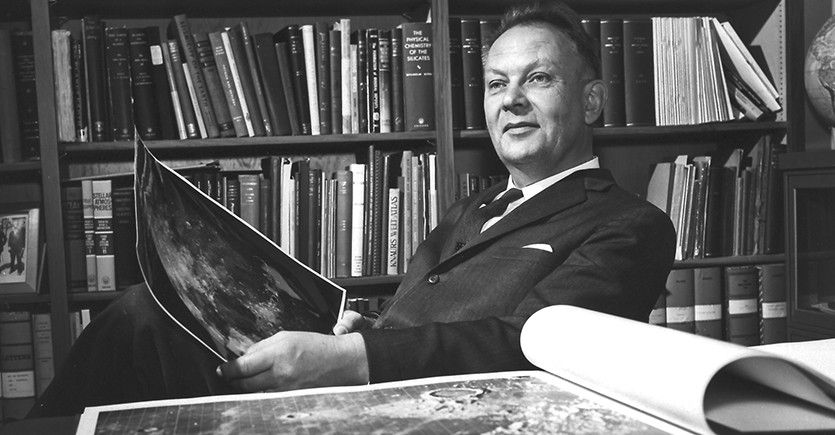
Gerard Kuiper

Harenkarspel, North Holland, Netherlands
Archival Overview
Dutch-American planetary scientist who discovered moons of Uranus and Neptune and predicted the Kuiper Belt.
Biographical Record
Gerard Peter Kuiper was a Dutch-born American planetary astronomer widely regarded as the father of modern planetary science. At a time when mainstream astrophysics focused almost exclusively on stars and distant galaxies, Kuiper dedicated his career to the telescopic and spectroscopic study of planets and satellites in our own solar system.
Using infrared spectroscopy, Kuiper made major planetary discoveries, including detecting methane in the atmosphere of Saturn's giant moon Titan (1944) and carbon dioxide on Mars (1947). He discovered Uranus's moon Miranda (1948) and Neptune's moon Nereid (1949). In 1951, he proposed that a belt of icy planetesimals had formed beyond Neptune that had failed to coalesce into a full planet—a theoretical reservoir confirmed four decades later as the Kuiper Belt. In the 1960s, Kuiper served as chief scientist for NASA's Ranger lunar probes, selecting landing sites for the Apollo missions. The Kuiper airborne observatory and NASA's Kuiper Belt honor his vision.
Key Life Milestones
Discovery of Atmosphere on Titan
Detected methane on Saturn's moon Titan, discovering the first moon in the solar system known to possess a dense atmosphere.
Prediction of the Kuiper Belt
Proposed the existence of an icy belt of primordial debris orbiting beyond Neptune, revolutionizing outer solar system models.
Memorial Guestbook & Tributes
0 messages recordedLeave a Respectful Tribute
Final Resting Place
Perpetual MemorialGreen Valley, Arizona, United States