 Russian Empire (Russia)
•
2,188 views
Russian Empire (Russia)
•
2,188 views
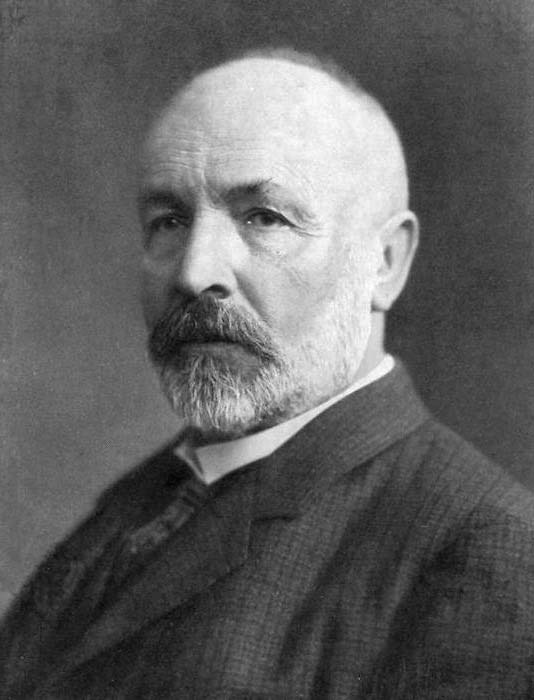
Georg Cantor

Saint Petersburg, Russian Empire (Russia)
Archival Overview
German mathematician who created set theory, transfinite arithmetic, and discovered that infinities come in different sizes.
Biographical Record
Georg Ferdinand Ludwig Philipp Cantor was a German mathematician whose astonishing creative vision invented modern set theory and tamed the concept of mathematical infinity. Born in Saint Petersburg and educated at the University of Berlin under Karl Weierstrass and Leopold Kronecker, Cantor spent his academic career at the University of Halle.
In 1874, Cantor published a paper demonstrating that the set of real numbers cannot be put into one-to-one correspondence with the set of natural numbers. Using his famous diagonal argument, he proved that infinity is not a single monolith: there are multiple, hierarchically distinct sizes of infinity, showing that the continuum of real numbers is strictly larger than the infinity of integers. He introduced transfinite cardinal numbers (aleph numbers: א₀, א₁...) and formulated the Continuum Hypothesis. Fiercely attacked by contemporaries like Kronecker who denounced him as a 'corrupter of youth', Cantor suffered bouts of severe depression, but was defended by David Hilbert, who famously proclaimed: 'No one shall expel us from the paradise that Cantor has created for us.'
Key Life Milestones
Uncountability of Real Numbers
Proved that real numbers cannot be put in one-to-one correspondence with integers, discovering that some infinities are larger than others.
The Diagonal Argument & Aleph Numbers
Published Cantor's diagonal argument proving power sets always have strictly greater cardinality than original sets.
Memorial Guestbook & Tributes
0 messages recordedLeave a Respectful Tribute
Final Resting Place
Perpetual MemorialHalle (Saale), Saxony-Anhalt, Germany