 United States
•
23 views
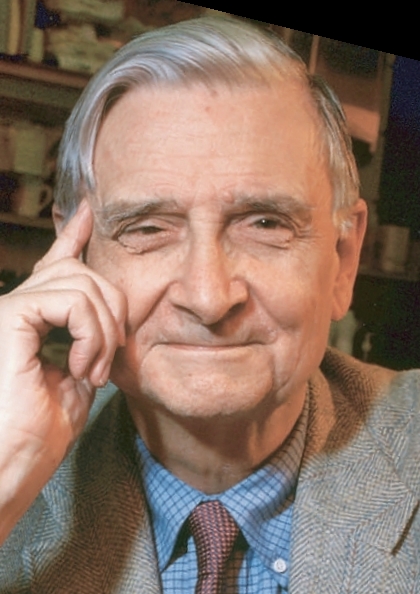
Edward Osborne Wilson

Birmingham, Alabama, United States
Archival Overview
Towering American evolutionary biologist, Harvard professor, and two-time Pulitzer Prize winner recognized as the world's leading authority on ants, the "father of biodiversity," and the founder of sociobiology.
Biographical Record
Edward Osborne Wilson grew up in Alabama and developed a fascination with nature after a childhood fishing accident impaired his stereoscopic vision, leading him to focus on small insects. Earning his doctorate from Harvard University, he spent four decades on Harvard's faculty, discovering hundreds of ant species and pioneering the chemical communication and social structures of insect societies.
With Robert MacArthur, Wilson formulated the equilibrium theory of island biogeography (1967), which became the foundation of modern conservation ecology. In 1975, his landmark book Sociobiology: The New Synthesis applied evolutionary theory to animal and human behavior. Wilson coined the term "biophilia"—humanity's innate affinity for the natural world—and championed the "Half-Earth" project to set aside half of Earth's surface to halt mass species extinction.
Key Life Milestones
Publication of Sociobiology: The New Synthesis
Published the seminal biological framework uniting evolutionary biology, population genetics, and social behavior.
Second Pulitzer Prize for The Ants
Awarded the Pulitzer Prize for General Nonfiction for his monumental entomological monograph co-authored with Bert Hölldobler.
Memorial Guestbook & Tributes
0 messages recordedLeave a Respectful Tribute
Final Resting Place
Perpetual MemorialBurlington, Massachusetts, United States