 Republic of China
•
3,981 views
Republic of China
•
3,981 views
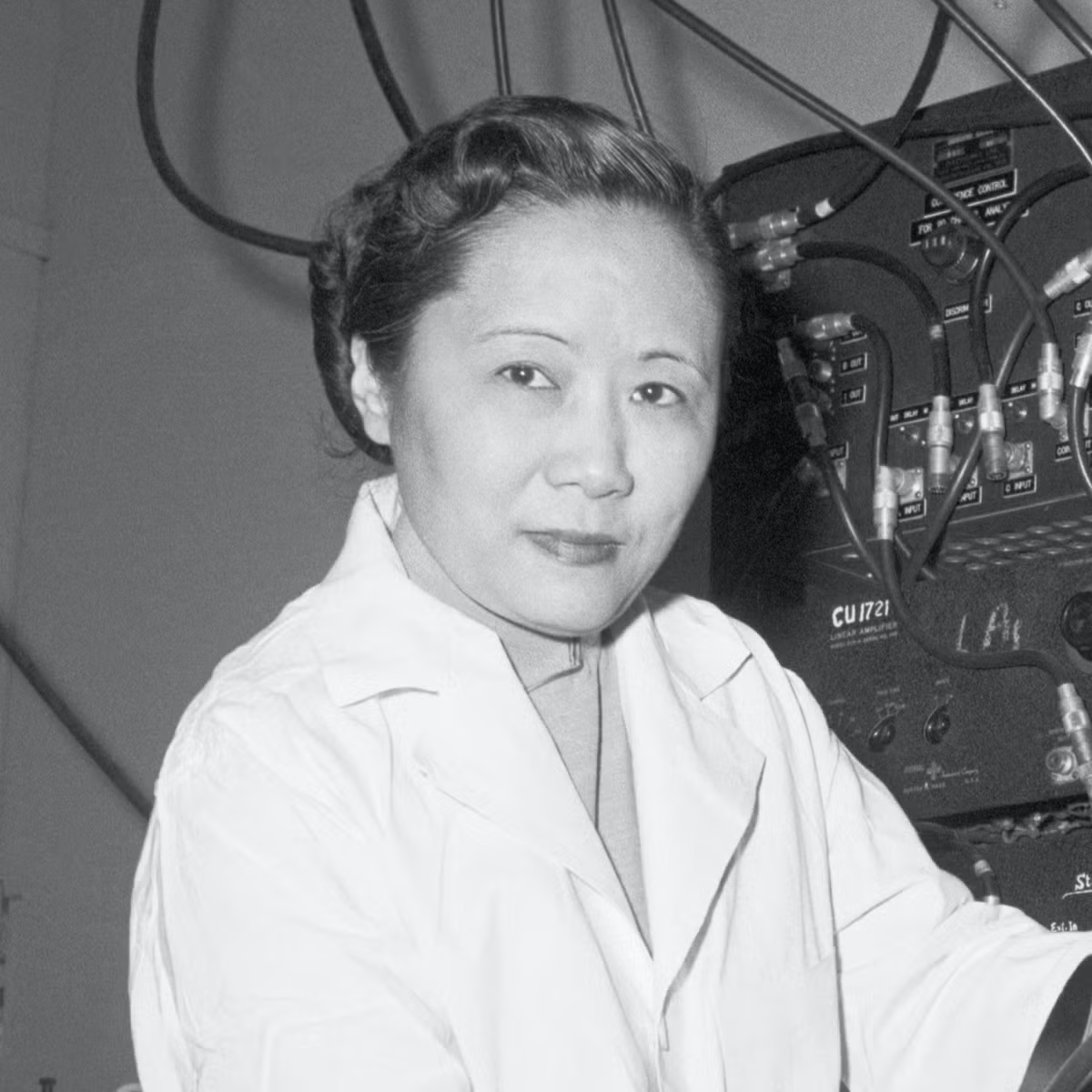
Chien-Shiung Wu

Taicang, Jiangsu, Republic of China
Archival Overview
Trailblazing experimental physicist known as the 'First Lady of Physics' who disproved the conservation of parity.
Biographical Record
Chien-Shiung Wu was a Chinese-American experimental physicist whose consummate precision earned her epithets such as 'the First Lady of Physics', 'the Chinese Marie Curie', and 'the Queen of Nuclear Research'. After studying at National Central University in Nanjing, she immigrated to the United States in 1936 to earn her doctorate at UC Berkeley under Ernest Lawrence. Recruited to the Manhattan Project at Columbia University, she made crucial contributions to gaseous diffusion uranium enrichment and solved the mystery of xenon poisoning in nuclear reactors.
In 1956, theoretical physicists Tsung-Dao Lee and Chen-Ning Yang proposed that parity might not be conserved in weak nuclear interactions and turned to Wu to test the hypothesis. Designing an ingenious experiment cooling cobalt-60 nuclei to near absolute zero inside a cryogenic solenoid, Wu proved conclusively that beta decay emitted electrons preferentially in a specific direction, violating parity conservation. While Lee and Yang received the 1957 Nobel Prize, Wu was unjustly excluded, though she later became the first female president of the American Physical Society and won the inaugural Wolf Prize in Physics.
Key Life Milestones
The Wu Experiment
Conducted the definitive cobalt-60 cryogenic experiment that shattered the long-standing physical law of conservation of parity in weak interactions.
Inaugural Wolf Prize in Physics
Awarded the first Wolf Prize in Physics for her pioneering experimental explorations of the weak interaction and the beta decay process.
Memorial Guestbook & Tributes
0 messages recordedLeave a Respectful Tribute
Final Resting Place
Perpetual MemorialLiuhe, Taicang, China