 India
•
21 views
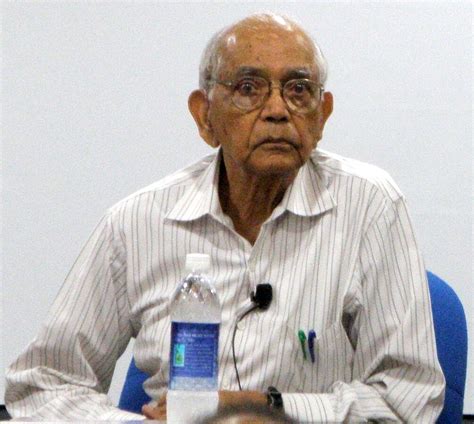
Calyampudi Radhakrishna Rao

Hadagali, India
Archival Overview
Centenarian Indian-American mathematician and statistician whose monumental discoveries in his twenties—including the Cramér-Rao bound, the Rao-Blackwell theorem, and Rao's score test—revolutionized modern statistics, machine learning, and econometrics.
Biographical Record
Calyampudi Radhakrishna Rao was born in Hadagali, Madras Presidency (modern Karnataka), India, the eighth of ten children. He earned master's degrees in mathematics and statistics from Andhra University and Calcutta University before completing his PhD at King's College, Cambridge, under geneticist and statistician Ronald Fisher in 1948.
In 1945, at the age of twenty-four, Rao published a single paper in the Bulletin of the Calcutta Mathematical Society that contained three foundational results in modern mathematical statistics: the Cramér-Rao inequality (defining the fundamental lower bound on the variance of an estimator), the Rao-Blackwell theorem (which transforms any estimator into an optimal estimator), and differential geometric approaches to probability distributions (information geometry). Rao served as director of the Indian Statistical Institute for four decades, establishing India as a global power in statistical science. He later held endowed chairs at Penn State and the University of Buffalo, receiving the US National Medal of Science in 2002 and the 2023 International Prize in Statistics (the "Nobel of statistics") at age 102.
Key Life Milestones
Publication of Seminal 1945 Paper
Published his historic paper formulating the Cramér-Rao inequality and Rao-Blackwell theorem at age twenty-four.
International Prize in Statistics
Awarded the International Prize in Statistics (often called the Nobel Prize of Statistics) at age 102 for his monumental lifetime achievements.
Memorial Guestbook & Tributes
0 messages recordedLeave a Respectful Tribute
Final Resting Place
Perpetual MemorialBuffalo, United States