 United States
•
4,190 views
United States
•
4,190 views
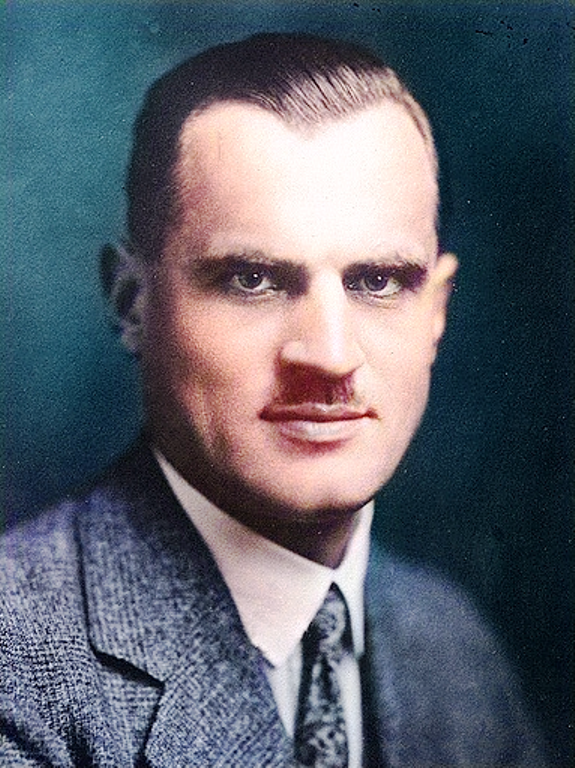
Arthur Compton

Wooster, Ohio, United States
Archival Overview
American physicist who discovered the Compton effect, conclusively proving that light behaves as particles with momentum.
Biographical Record
Arthur Holly Compton was an eminent American physicist whose experimental discoveries provided indisputable proof of the quantum nature of electromagnetic radiation. Raised in an academic family in Wooster, Ohio, Compton studied at Princeton and Cambridge before heading the physics department at Washington University in St. Louis.
In 1923, Compton bombarded graphite targets with monochromatic X-rays and observed that the scattered X-rays had longer wavelengths (lower energy) than the incident beam, depending directly on the angle of scatter. Applying Einstein's photon hypothesis and relativistic conservation laws, he proved that X-rays collide with electrons like billiard balls—exchanging both energy and particle momentum. This Compton effect convinced the international physics community that electromagnetic waves truly behave as discrete particles (photons), earning Compton the 1927 Nobel Prize in Physics. During World War II, he led the Metallurgical Laboratory at the University of Chicago, directing Enrico Fermi's creation of the Chicago Pile-1—the world's first artificial nuclear reactor.
Key Life Milestones
Discovery of the Compton Effect
Demonstrated the particle nature of light by observing wavelength shifts when X-rays scatter off atomic electrons.
Nobel Prize in Physics
Awarded the Nobel Prize in Physics for his discovery of the effect bearing his name, cementing quantum theory.
Memorial Guestbook & Tributes
0 messages recordedLeave a Respectful Tribute
Final Resting Place
Perpetual MemorialWooster, Ohio, United States