 United Kingdom
•
1,658 views
United Kingdom
•
1,658 views
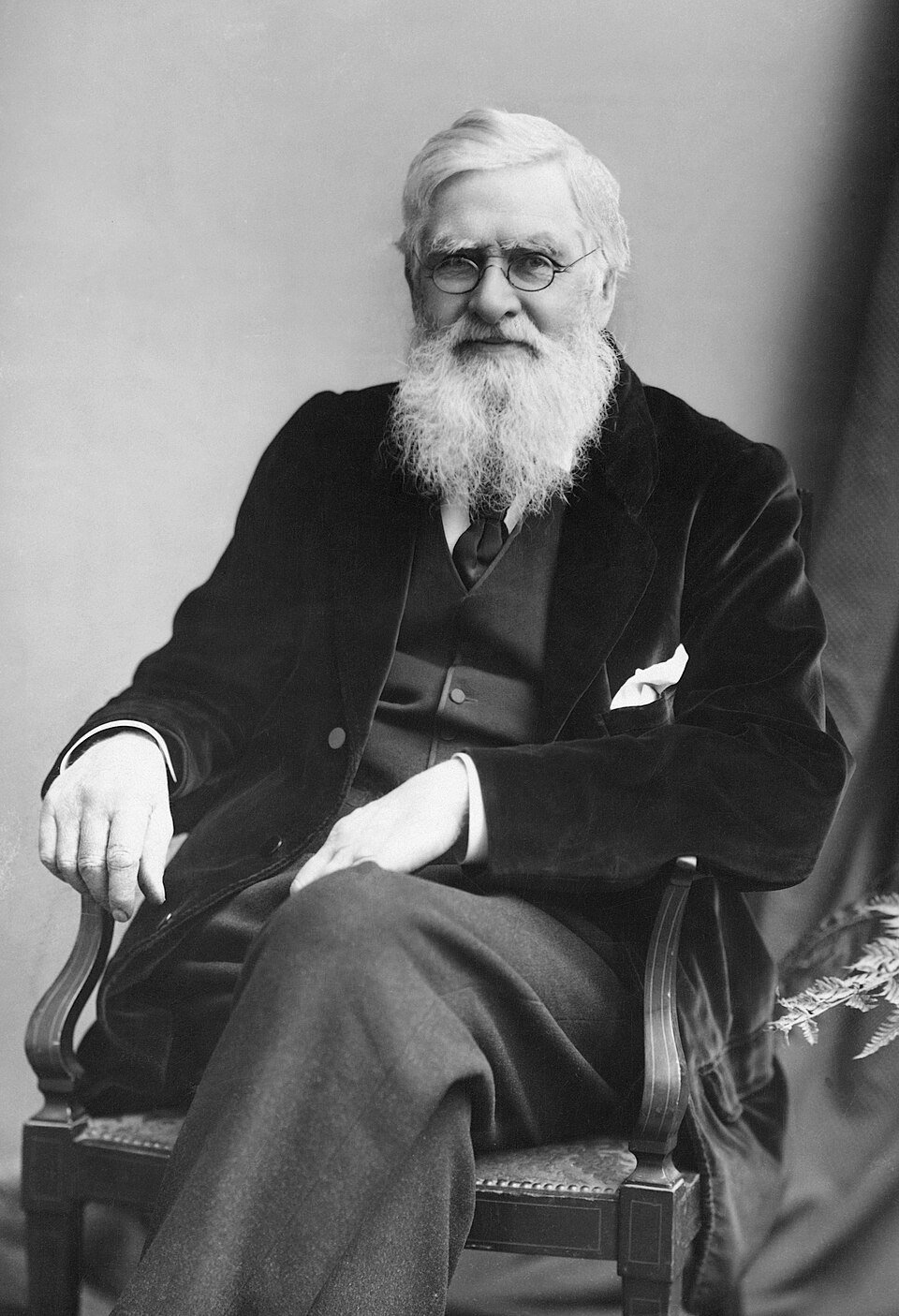
Alfred Russel Wallace

Llanbadoc, Monmouthshire, United Kingdom
Archival Overview
British naturalist and explorer who independently conceived the theory of evolution through natural selection and founded biogeography.
Biographical Record
Alfred Russel Wallace was an intrepid British naturalist, geographer, anthropologist, and social reformer whose field expeditions in the Amazon River basin and the Malay Archipelago led him to independently discover the principle of natural selection. Self-educated and self-funded through collecting exotic biological specimens, Wallace spent eight years in Southeast Asia, amassing over 125,000 biological specimens.
In 1858, while delirious with malaria on the Indonesian island of Ternate, Wallace experienced an epiphany: that variations conferring advantages in the struggle for existence ensure survival and evolutionary change. He wrote an essay outlining his theory and mailed it to Charles Darwin, who was shocked to find his own unpublished ideas of twenty years mirrored with breathtaking precision. Their joint paper was read to the Linnean Society of London on July 1, 1858, prompting Darwin to publish On the Origin of Species. Wallace also discovered the faunal boundary separating Asian and Australasian animal species across Indonesia, forever celebrated as the Wallace Line, establishing evolutionary biogeography.
Key Life Milestones
The Ternate Essay on Natural Selection
Authored the essay on evolution by natural selection that prompted the joint presentation with Charles Darwin at the Linnean Society.
Identification of the Wallace Line
Identified the sharp biogeographical boundary dividing Asian and Australian fauna across the Indonesian archipelago.
Memorial Guestbook & Tributes
0 messages recordedLeave a Respectful Tribute
Final Resting Place
Perpetual MemorialBroadstone, Dorset, United Kingdom