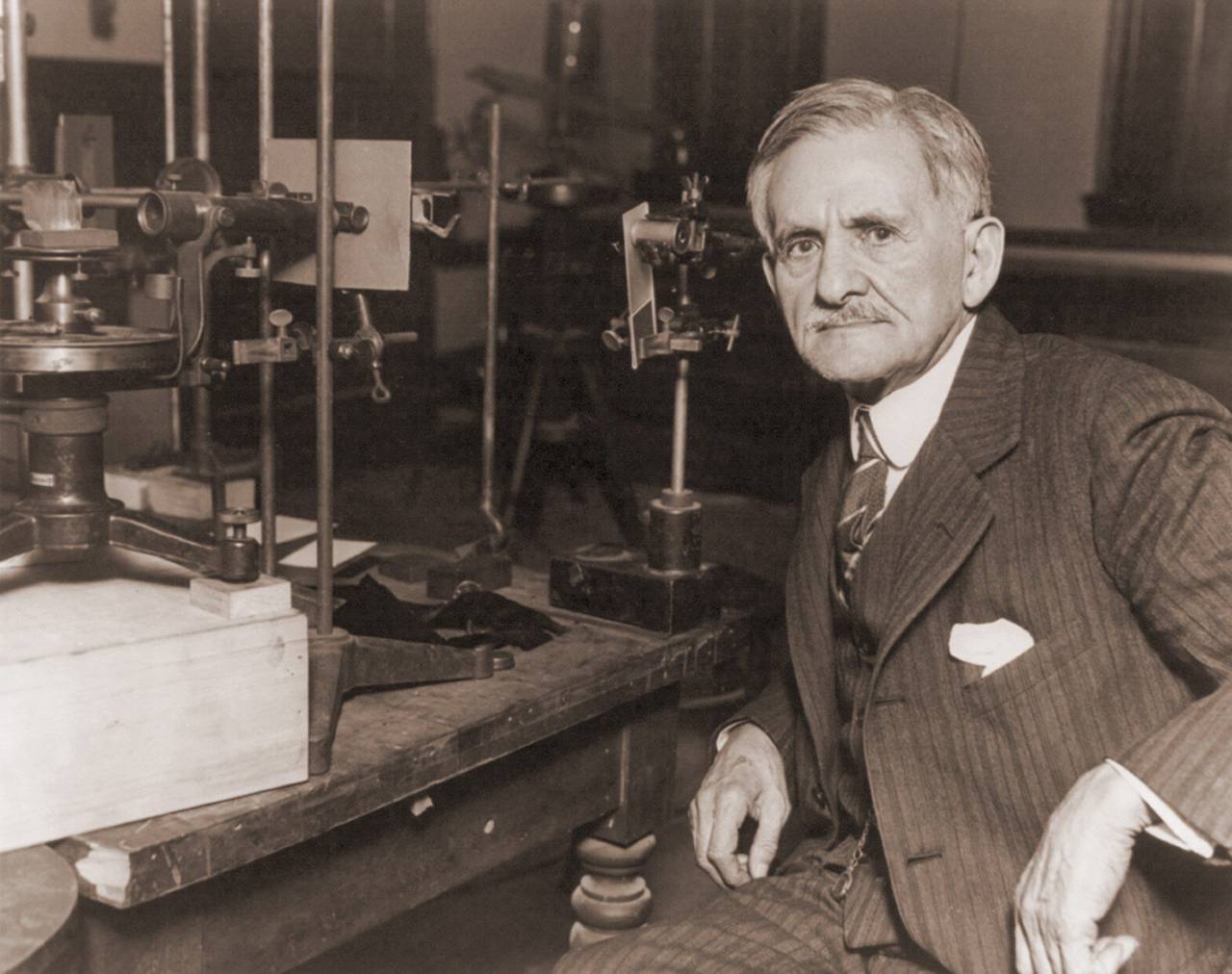
 Kingdom of Prussia (Poland)
•
2,016 views
Kingdom of Prussia (Poland)
•
2,016 views
Albert A. Michelson

Strzelno, Posen, Kingdom of Prussia (Poland)
Archival Overview
Master experimentalist whose Michelson-Morley interferometer experiment disproved the luminiferous aether.
Biographical Record
Albert Abraham Michelson was an American physicist celebrated for his extraordinary precision in optical measurements and for carrying out the pivotal experiment that paved the way for Einstein's special theory of relativity. Born in Prussian Poland and raised in Nevada mining camps and San Francisco, he graduated from the United States Naval Academy before dedicating his life to physics.
Inventing the Michelson interferometer, he split a beam of light into perpendicular paths and recombined them to produce optical interference fringes of breathtaking sensitivity. In 1887, with Edward W. Morley at Case Western Reserve University, he performed the historic Michelson-Morley experiment to detect Earth's motion through the hypothesized 'luminiferous aether'. The famous null result—proving the speed of light is constant in all inertial frames regardless of Earth's motion—disproved the aether and formed the empirical foundation of relativity. In 1907, Michelson became the first American to win a Nobel Prize in the sciences.
Key Life Milestones
The Michelson-Morley Experiment
Conducted the most famous 'failed' experiment in science history, demonstrating that the speed of light is invariant and the aether does not exist.
First American Science Nobel Prize
Became the first American citizen to receive a Nobel Prize, honored in Physics for his optical precision instruments and spectroscopic investigations.
Memorial Guestbook & Tributes
0 messages recordedLeave a Respectful Tribute
Final Resting Place
Perpetual MemorialAltadena, California, United States