 United Kingdom
•
2 views
United Kingdom
•
2 views
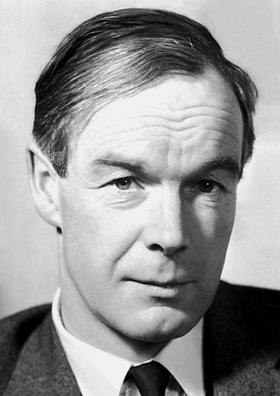
Alan Hodgkin

Banbury (Oxfordshire), United Kingdom
Archival Overview
English biophysicist who won the 1963 Nobel Prize in Medicine alongside Andrew Huxley for discovering the ionic mechanisms involved in excitation and inhibition in the peripheral and central parts of the nerve cell membrane.
Biographical Record
Sir Alan Hodgkin (1914–1998) worked on airborne centimetric radar during World War II, helping invent the H2S radar system that guided Allied bombers. Returning to the Marine Biological Association laboratory in Plymouth, Hodgkin and Andrew Huxley inserted micro-electrodes inside the giant axon of the Atlantic squid (Loligo forbesii).
In 1952, using the voltage clamp technique, Hodgkin and Huxley published five historic papers in the Journal of Physiology demonstrating that the action potential is generated by rapid influx of sodium ions followed by efflux of potassium ions, formulating the mathematical differential equations (Hodgkin-Huxley model) that govern modern electrophysiology.
Key Life Milestones
Publication of the Hodgkin-Huxley Model
Published the mathematical equations describing the voltage-gated sodium and potassium channels of nerve impulses.
Awarded the Nobel Prize in Medicine
Received the Nobel Prize alongside Andrew Huxley and John Eccles for ionic mechanisms of nerve conduction.
Memorial Guestbook & Tributes
0 messages recordedLeave a Respectful Tribute
Final Resting Place
Perpetual MemorialCambridge, United Kingdom